
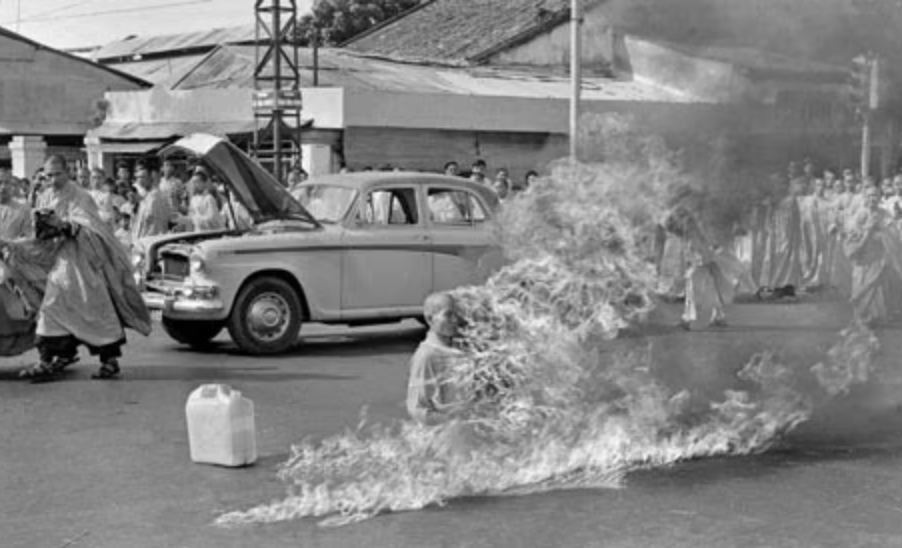
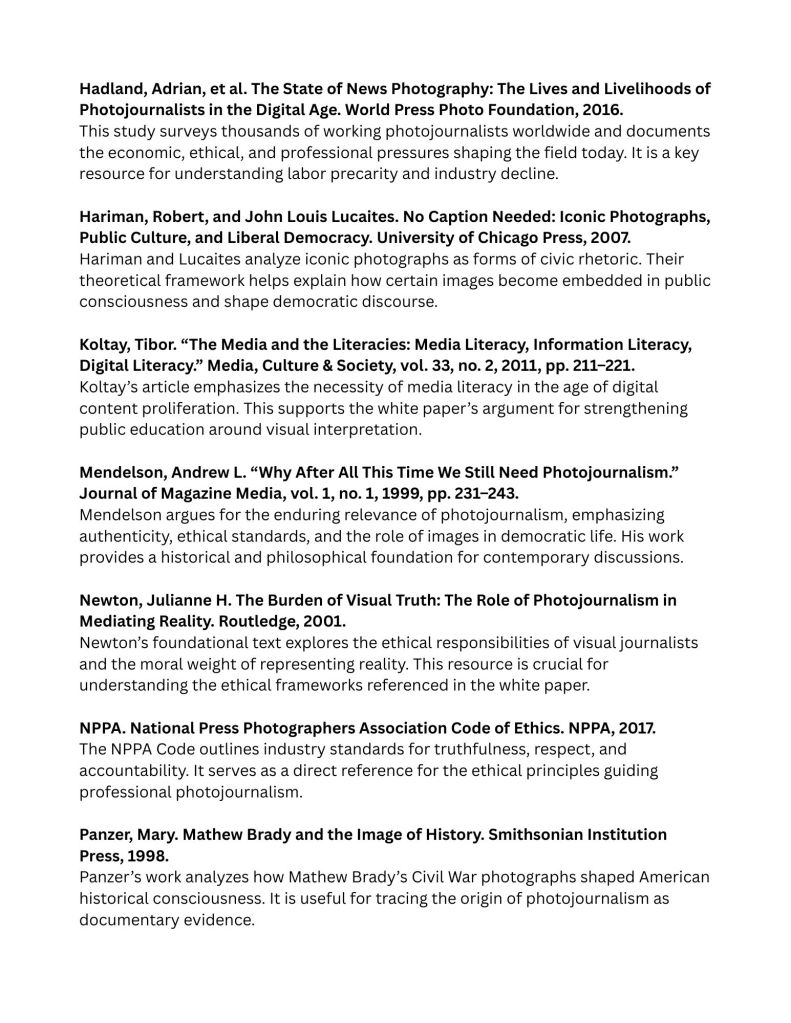
https://www.apimages.com/metadata/Index/AP-WWII-Vietnam-Protest-Monk/1f901984823f4b63aca8b2e4c01aa4dd/1/0
Executive Summary
Photojournalism occupies a uniquely powerful position within contemporary media, functioning as both a documentary practice and a form of public evidence in a moment when truth is increasingly hard to find. As images now circulate through algorithmic platforms at unprecedented speed and artificial intelligence blurs the boundaries between authentic and synthetic visuals, the credibility of visual reporting has never been more essential. Human photojournalists bring ethical judgment, contextual understanding, and narrative intentionality to their work, creating images that shape public understanding and preserve historical truth in ways that automated or unverified digital imagery cannot. Their photographs anchor societal memory, challenge institutional power, and resist the growing influence of misinformation. In an era defined by visual overload and instability, ethically grounded human centered photojournalism remains indispensable to democratic accountability and the public’s ability to discern reality.
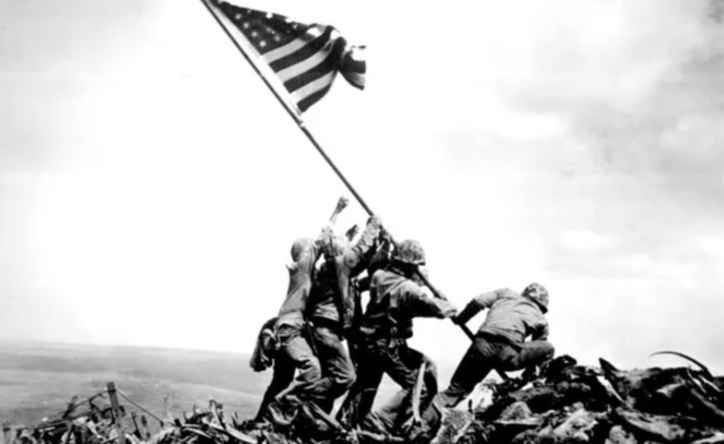
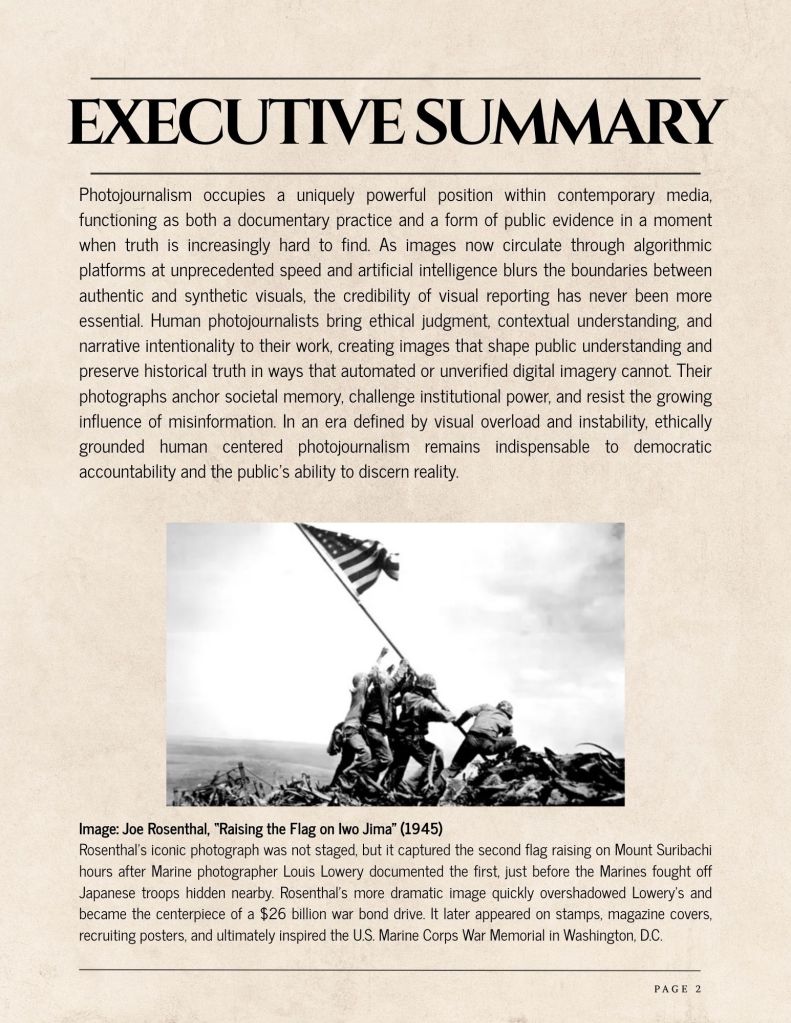
Rosenthal’s iconic photograph was not staged, but it captured the second flag raising on Mount Suribachi hours after Marine photographer Louis Lowery documented the first, just before the Marines fought off Japanese troops hidden nearby. Rosenthal’s more dramatic image quickly overshadowed Lowery’s and became the centerpiece of a $26 billion war bond drive. It later appeared on stamps, magazine covers, recruiting posters, and ultimately inspired the U.S. Marine Corps War Memorial in Washington, D.C.
Introduction
The contemporary media landscape is saturated with imagery, fleeting visuals produced, shared, remixed, and forgotten within minutes. Digital platforms, networked technologies, and algorithmic distribution have transformed how photographs emerge and circulate, shaping a visual culture defined by immediacy, abundance, and rapid obsolescence. Amid this accelerated image economy, traditional photojournalism faces unprecedented pressures, from dwindling newsroom resources to the existential threat of AI-generated imagery.
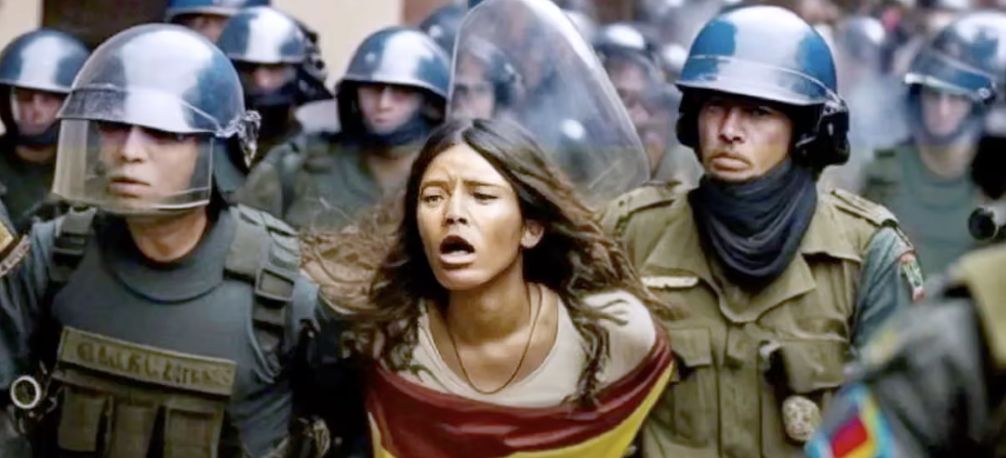
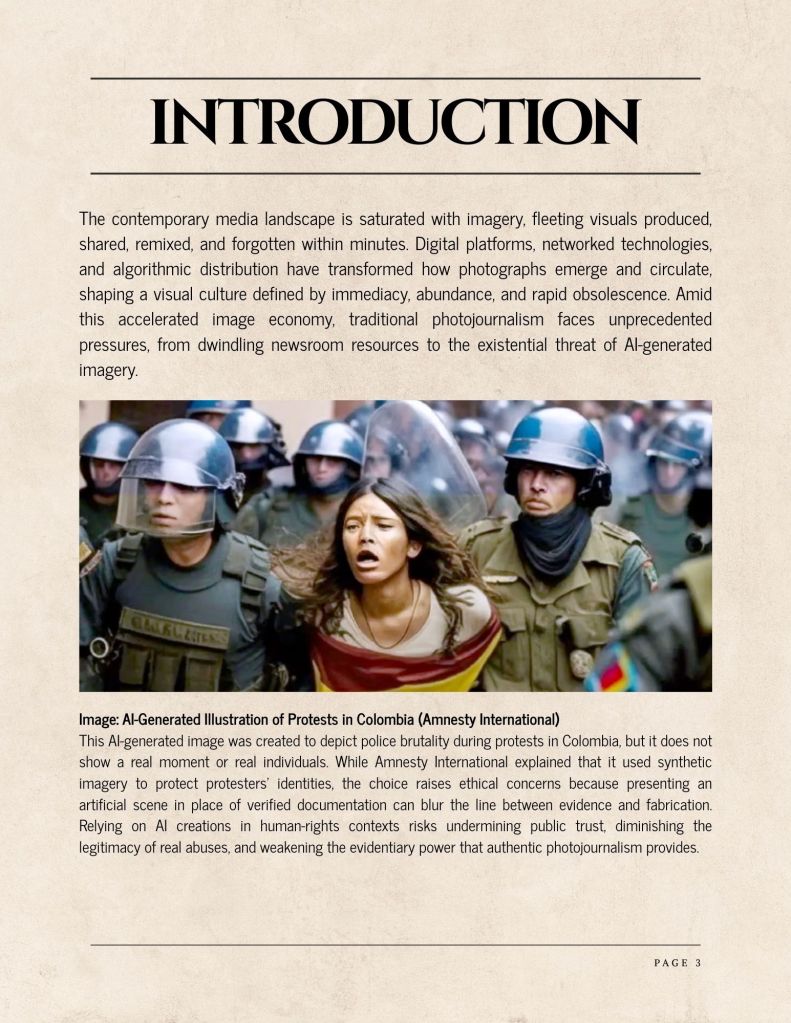
This AI-generated image was created to depict police brutality during protests in Colombia, but it does not show a real moment or real individuals. While Amnesty International explained that it used synthetic imagery to protect protesters’ identities, the choice raises ethical concerns because presenting an artificial scene in place of verified documentation can blur the line between evidence and fabrication. Relying on AI creations in human-rights contexts risks undermining public trust, diminishing the legitimacy of real abuses, and weakening the evidentiary power that authentic photojournalism provides.
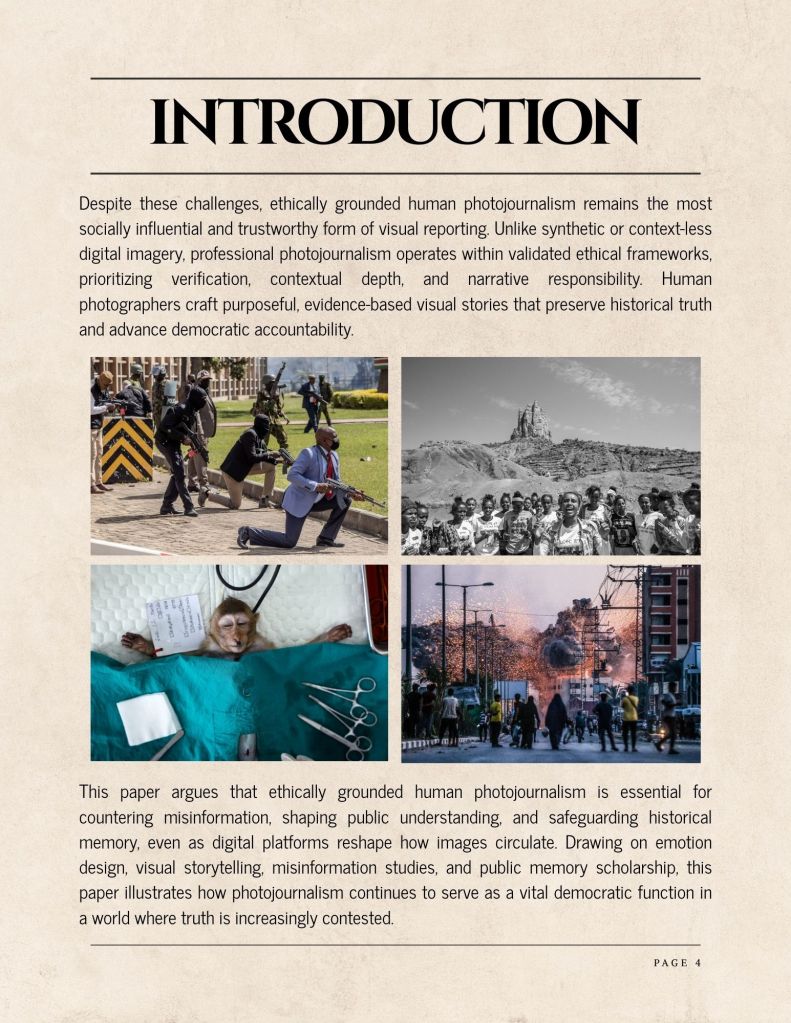
Despite these challenges, ethically grounded human photojournalism remains the most socially influential and trustworthy form of visual reporting. Unlike synthetic or context-less digital imagery, professional photojournalism operates within validated ethical frameworks, prioritizing verification, contextual depth, and narrative responsibility. Human photographers craft purposeful, evidence-based visual stories that preserve historical truth and advance democratic accountability.
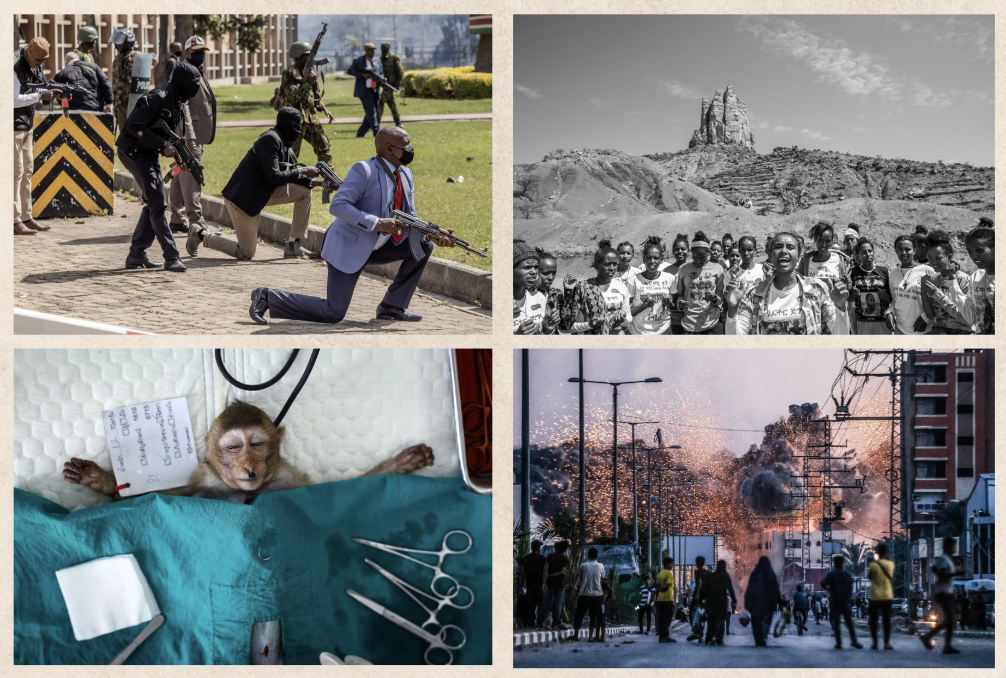
This blog argues that ethically grounded human photojournalism is essential for countering misinformation, shaping public understanding, and safeguarding historical memory, even as digital platforms reshape how images circulate. Drawing on emotion design, visual storytelling, misinformation studies, and public memory scholarship, this paper illustrates how photojournalism continues to serve as a vital democratic function in a world where truth is increasingly contested.
The Emotional and Cognitive Authority of Photographic Evidence
Emotional Design and Photographic Interpretation
Photography’s social impact is rooted in its ability to convey pure emotional or psychological realities that cannot be communicated through text alone. Emotional design research demonstrates that images operate through rapid perceptual processes that bypass rational analysis (Norman and Ortony). Color, contrast, expression, and framing that creates emotions that shape how audiences interpret life events.
Emotional responses significantly influence cognitive processing, allowing photographs to communicate meaning more quickly and impactful than text alone. In high-stakes contexts such as political unrest, natural disasters, or humanitarian crises, this immediacy becomes especially powerful because viewers instinctively interpret visual cues to shape their emotions around the events. To harness this effect responsibly, photojournalists draw on principles of color theory, perspective, and compositional hierarchy using contrast, depth, focal points, and directional lines to guide attention and clarify emotional tone. These visual decisions help turn chaotic or fragmented environments into coherent, legible narratives that audiences can understand within seconds, reinforcing the photograph’s role as both documentation and emotional storytelling (Cao).

“Afghan Girl” by Steve McCurry
This iconic portrait masterfully uses color theory with the striking complementary contrast between the subject’s intense green eyes and the rich red and orange tones of her scarf and the background. This contrast creates a powerful focal point, immediately drawing attention to her face and conveying a strong, compelling emotional intensity.
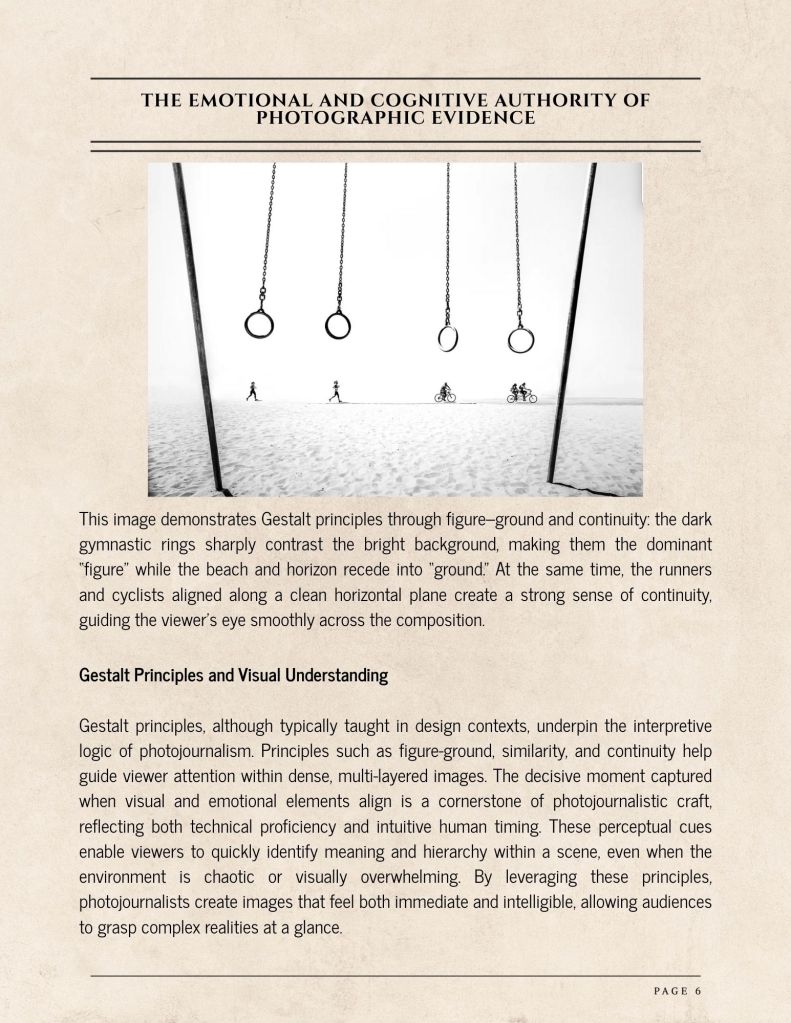
This image below, demonstrates Gestalt principles through figure–ground and continuity: the dark gymnastic rings sharply contrast the bright background, making them the dominant “figure” while the beach and horizon recede into “ground.” At the same time, the runners and cyclists aligned along a clean horizontal plane create a strong sense of continuity, guiding the viewer’s eye smoothly across the composition.

Gestalt Principles and Visual Understanding
Gestalt principles, although typically taught in design contexts, underpin the interpretive logic of photojournalism. Principles such as figure-ground, similarity, and continuity help guide viewer attention within dense, multi-layered images. The decisive moment captured when visual and emotional elements align is a cornerstone of photojournalistic craft, reflecting both technical proficiency and intuitive human timing. These perceptual cues enable viewers to quickly identify meaning and hierarchy within a scene, even when the environment is chaotic or visually overwhelming. By leveraging these principles, photojournalists create images that feel both immediate and intelligible, allowing audiences to grasp complex realities at a glance.
Iconic Images and Public Interpretation
“Napalm Girl” and Ethical Witnessing
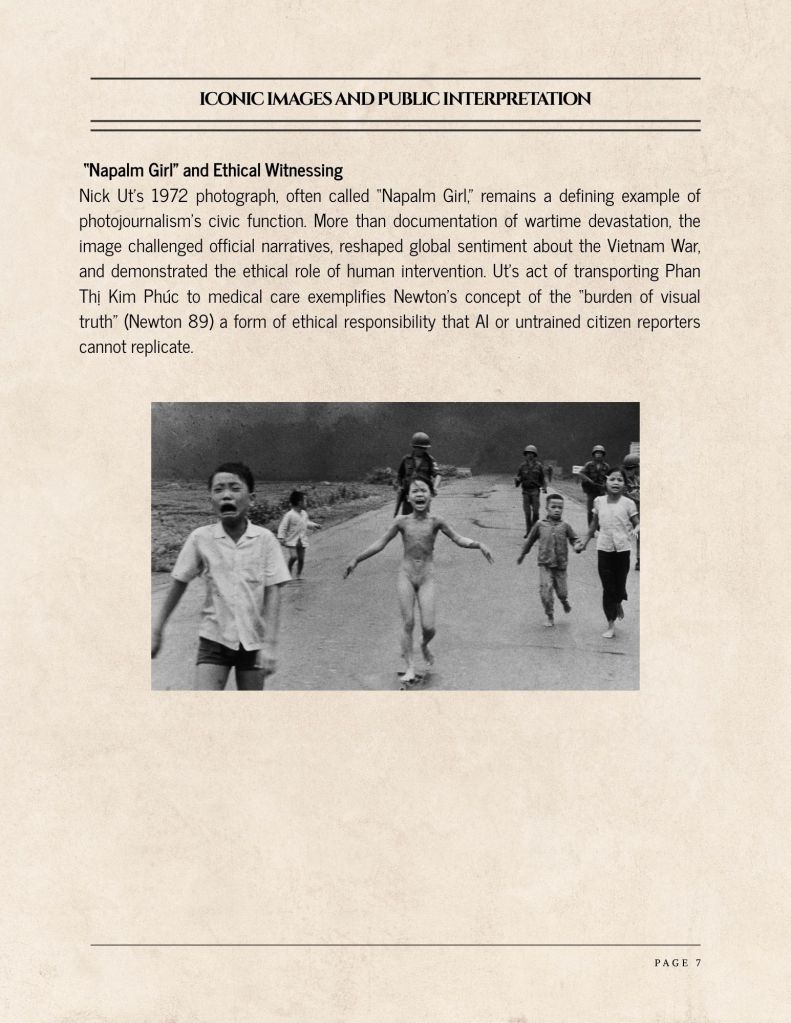
Nick Ut’s 1972 photograph, often called “Napalm Girl,” remains a defining example of photojournalism’s civic function. More than documentation of wartime devastation, the image challenged official narratives, reshaped global sentiment about the Vietnam War, and demonstrated the ethical role of human intervention. Ut’s act of transporting Phan Thị Kim Phúc to medical care exemplifies Newton’s concept of the “burden of visual truth” (Newton 89) a form of ethical responsibility that AI or untrained citizen reporters cannot replicate.

Iconic Imagery and Collective Memory
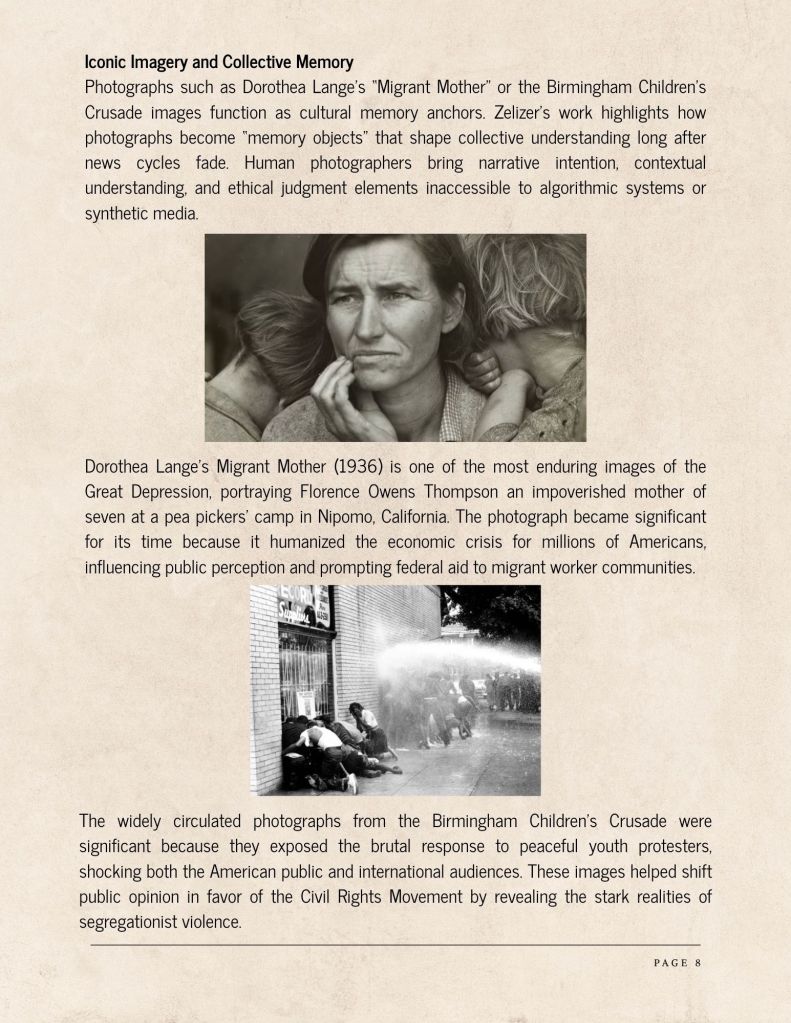
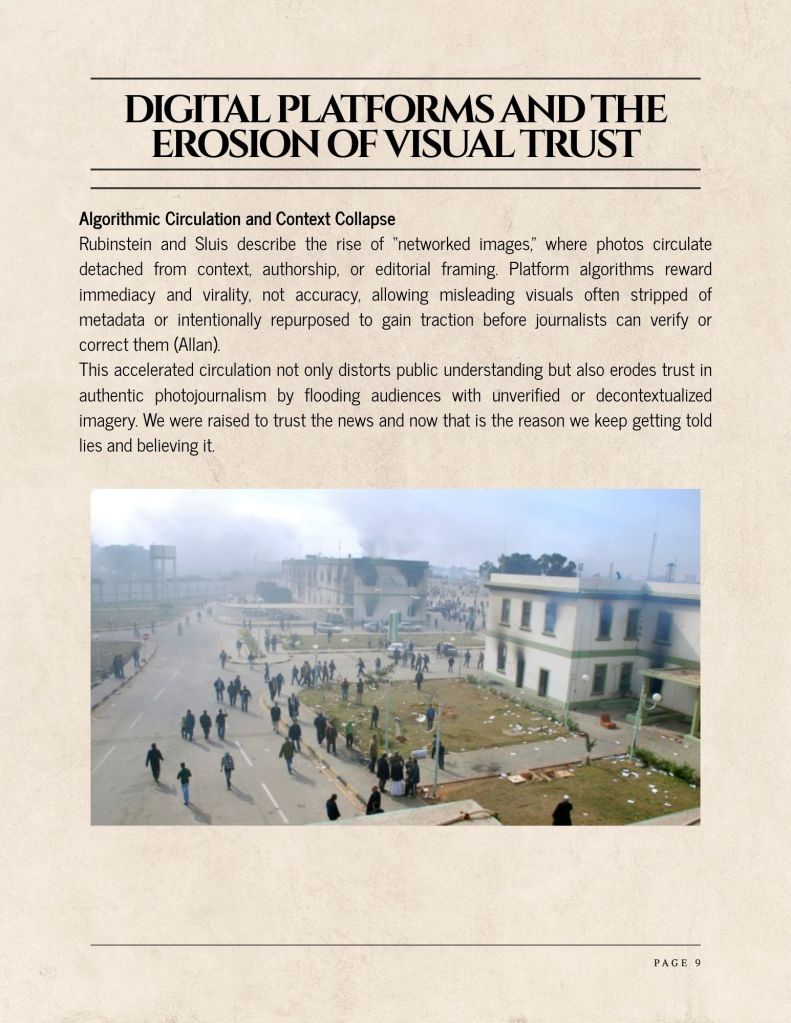
Photographs such as Dorothea Lange’s “Migrant Mother” or the Birmingham Children’s Crusade images function as cultural memory anchors. Zelizer’s work highlights how photographs become “memory objects” that shape collective understanding long after news cycles fade. Human photographers bring narrative intention, contextual understanding, and ethical judgment elements inaccessible to algorithmic systems or synthetic media.

Dorothea Lange’s Migrant Mother (1936) is one of the most enduring images of the Great Depression, portraying Florence Owens Thompson an impoverished mother of seven at a pea pickers’ camp in Nipomo, California. The photograph became significant for its time because it humanized the economic crisis for millions of Americans, influencing public perception and prompting federal aid to migrant worker communities.
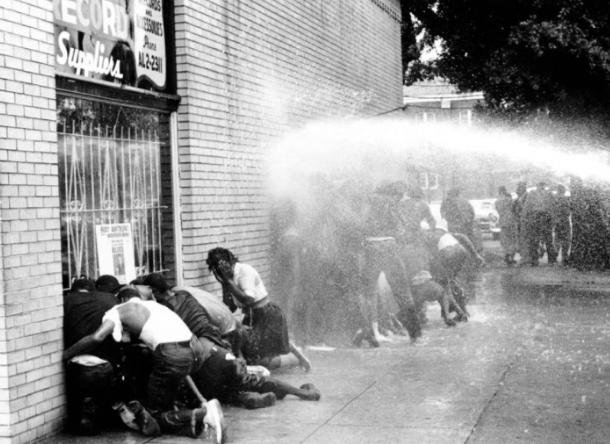
The widely circulated photographs from the Birmingham Children’s Crusade were significant because they exposed the brutal response to peaceful youth protesters, shocking both the American public and international audiences. These images helped shift public opinion in favor of the Civil Rights Movement by revealing the stark realities of segregationist violence.
Digital Platforms and the Erosion of Visual Trust
Algorithmic Circulation and Context Collapse
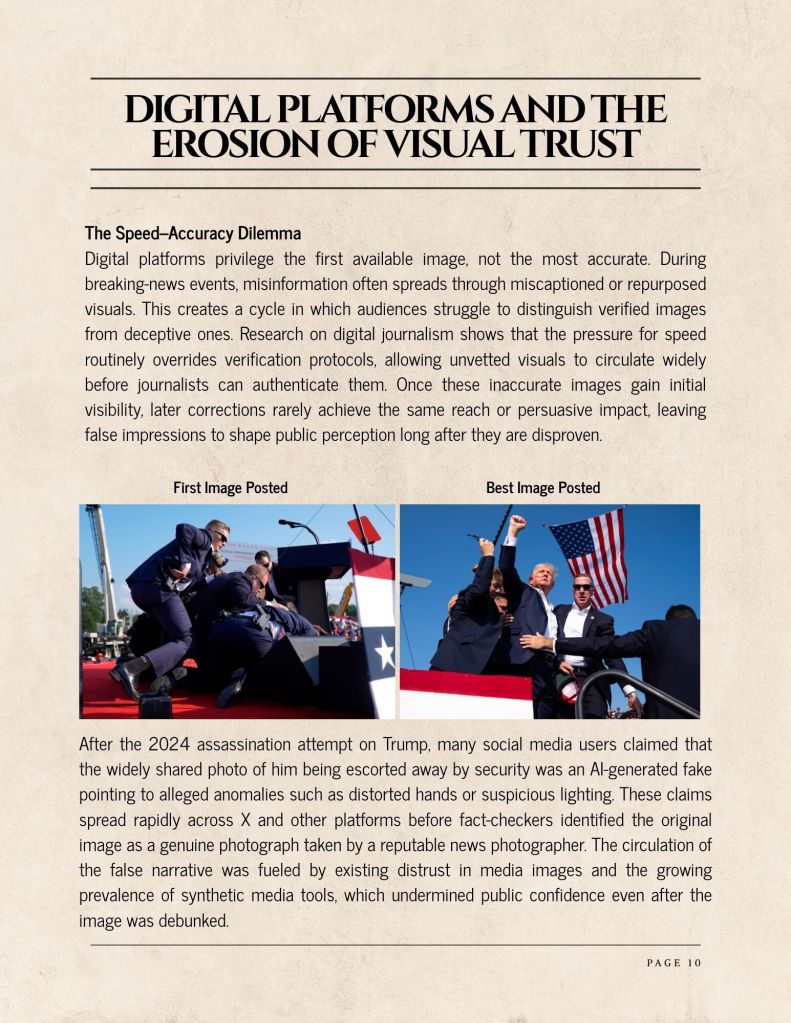
Rubinstein and Sluis describe the rise of “networked images,” where photos circulate detached from context, authorship, or editorial framing. Platform algorithms reward immediacy and virality, not accuracy, allowing misleading visuals often stripped of metadata or intentionally repurposed to gain traction before journalists can verify or correct them (Allan).
This accelerated circulation not only distorts public understanding but also erodes trust in authentic photojournalism by flooding audiences with unverified or decontextualized imagery. We were raised to trust the news and now that is the reason we keep getting told lies and believing it.
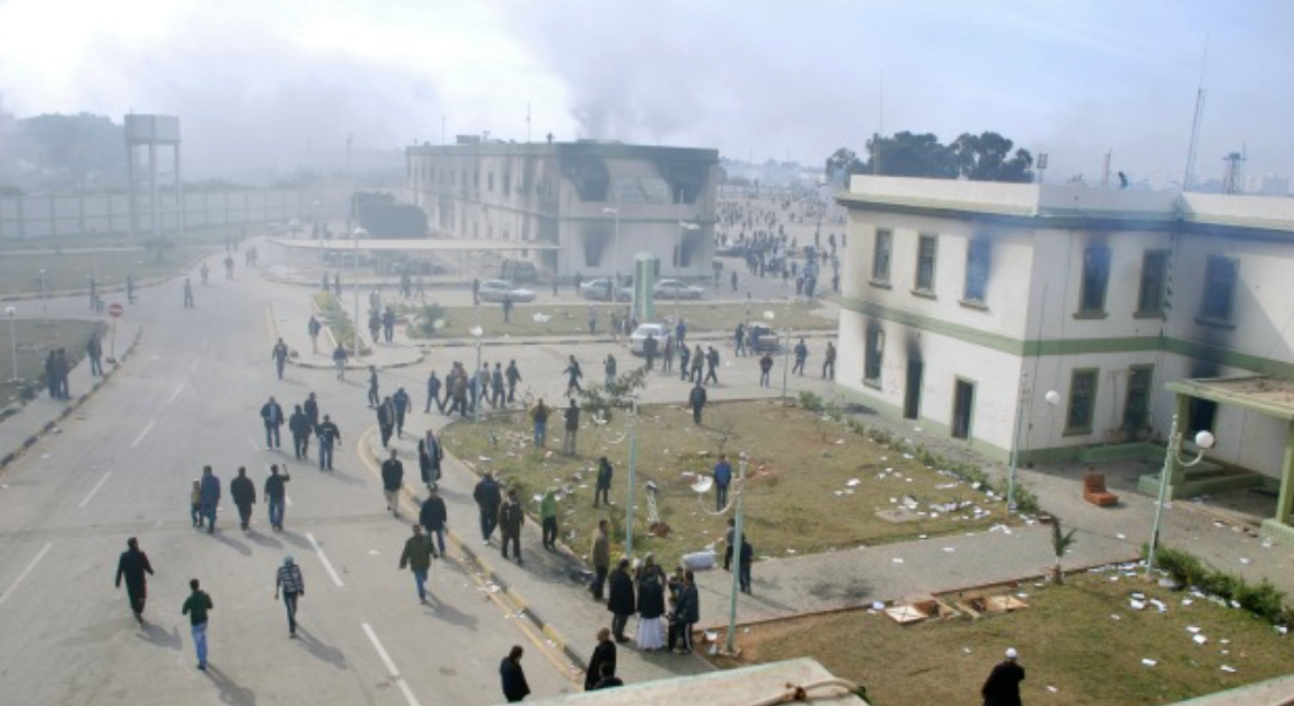
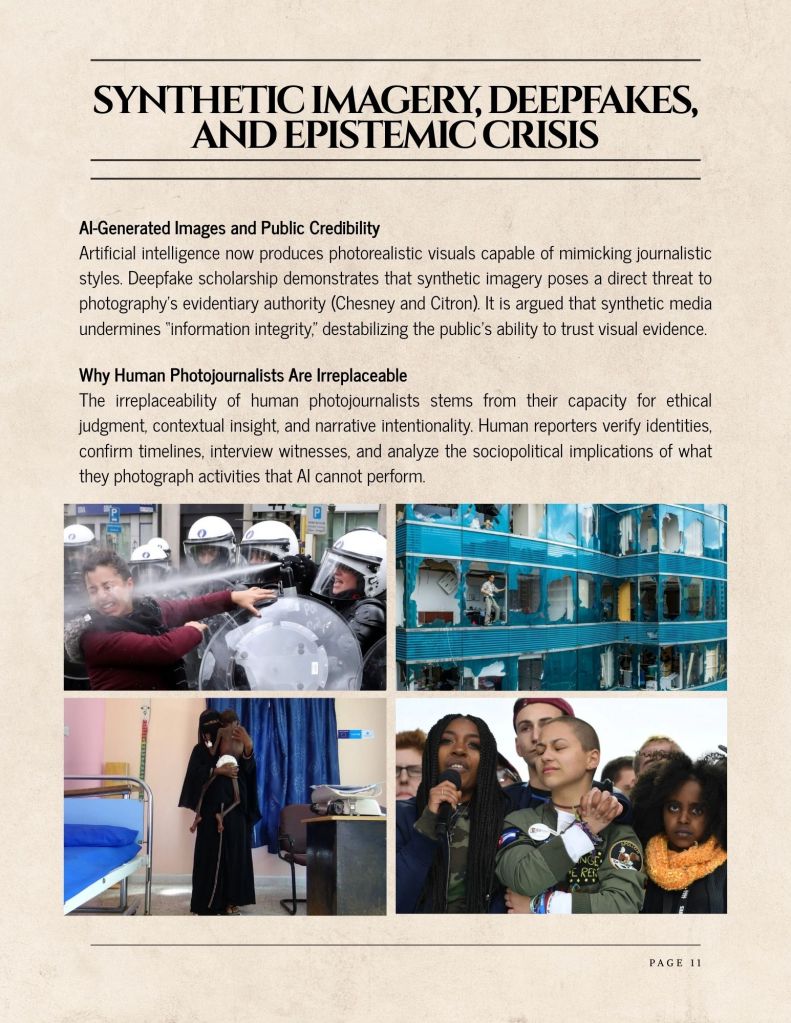
Digital platforms privilege the first available image, not the most accurate. During breaking-news events, misinformation often spreads through miscaptioned or repurposed visuals. This creates a cycle in which audiences struggle to distinguish verified images from deceptive ones. Research on digital journalism shows that the pressure for speed routinely overrides verification protocols, allowing unvetted visuals to circulate widely before journalists can authenticate them. Once these inaccurate images gain initial visibility, later corrections rarely achieve the same reach or persuasive impact, leaving false impressions to shape public perception long after they are disproven.
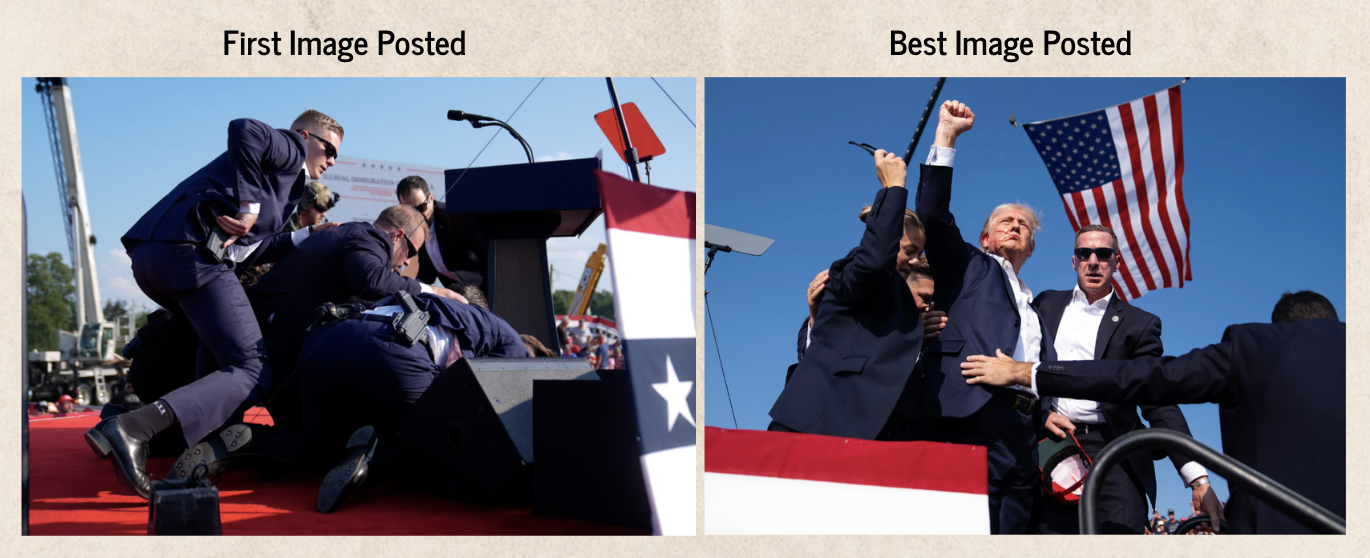
After the 2024 assassination attempt on Trump, many social media users claimed that the widely shared photo of him being escorted away by security was an AI-generated fake pointing to alleged anomalies such as distorted hands or suspicious lighting. These claims spread rapidly across X and other platforms before fact-checkers identified the original image as a genuine photograph taken by a reputable news photographer. The circulation of the false narrative was fueled by existing distrust in media images and the growing prevalence of synthetic media tools, which undermined public confidence even after the image was debunked.
Synthetic Imagery, Deepfakes, and Epistemic Crisis
AI-Generated Images and Public Credibility
Artificial intelligence now produces photorealistic visuals capable of mimicking journalistic styles. Deepfake scholarship demonstrates that synthetic imagery poses a direct threat to photography’s evidentiary authority (Chesney and Citron). It is argued that synthetic media undermines “information integrity,” destabilizing the public’s ability to trust visual evidence.
Why Human Photojournalists Are Irreplaceable
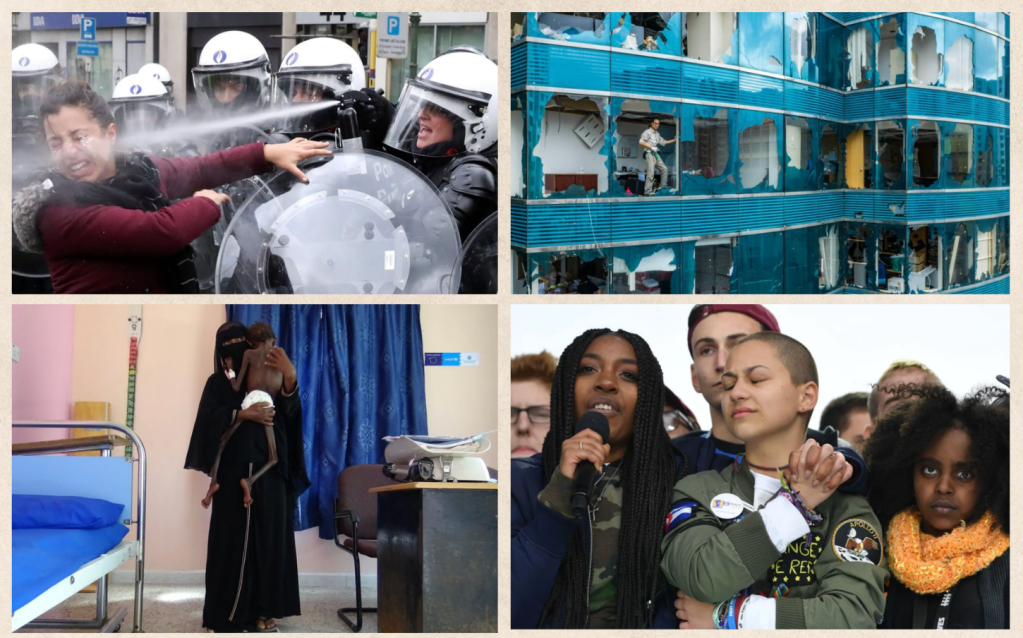
The irreplaceability of human photojournalists stems from their capacity for ethical judgment, contextual insight, and narrative intentionality. Human reporters verify identities, confirm timelines, interview witnesses, and analyze the sociopolitical implications of what they photograph activities that AI cannot perform.
Ethics as the Foundation of Public Trust
The NPPA Code of Ethics and the Importance of Authenticity
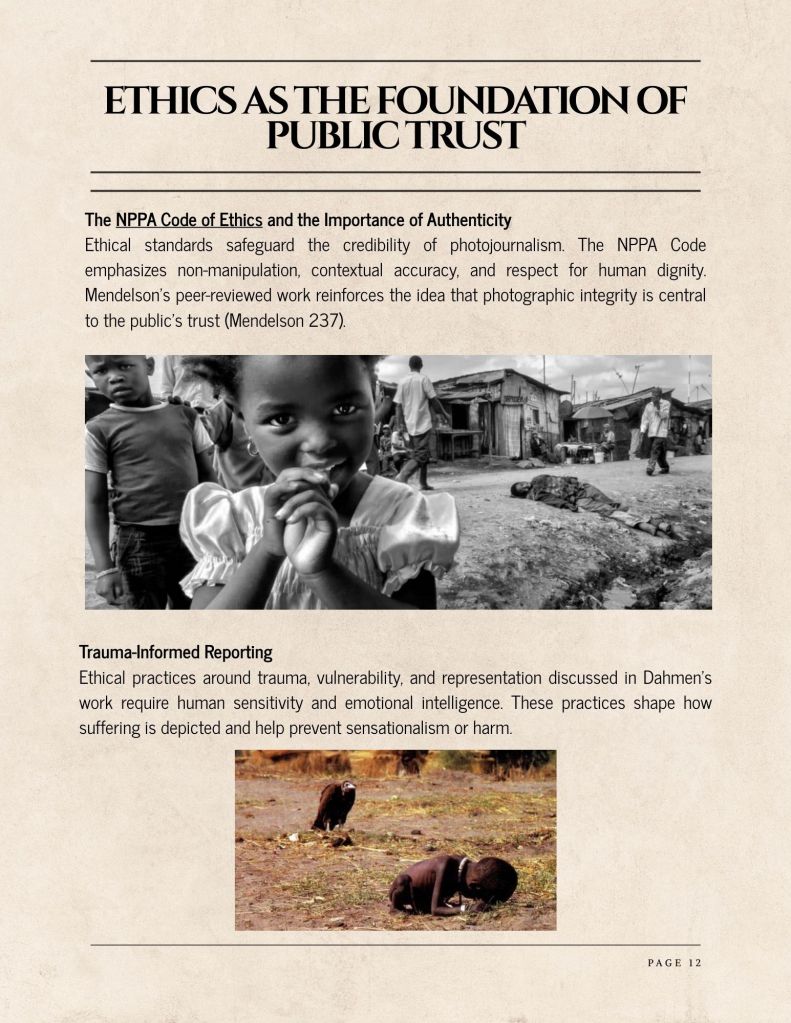
Ethical standards safeguard the credibility of photojournalism. The NPPA Code emphasizes non-manipulation, contextual accuracy, and respect for human dignity. Mendelson’s peer-reviewed work reinforces the idea that photographic integrity is central to the public’s trust (Mendelson 237).
Trauma-Informed Reporting
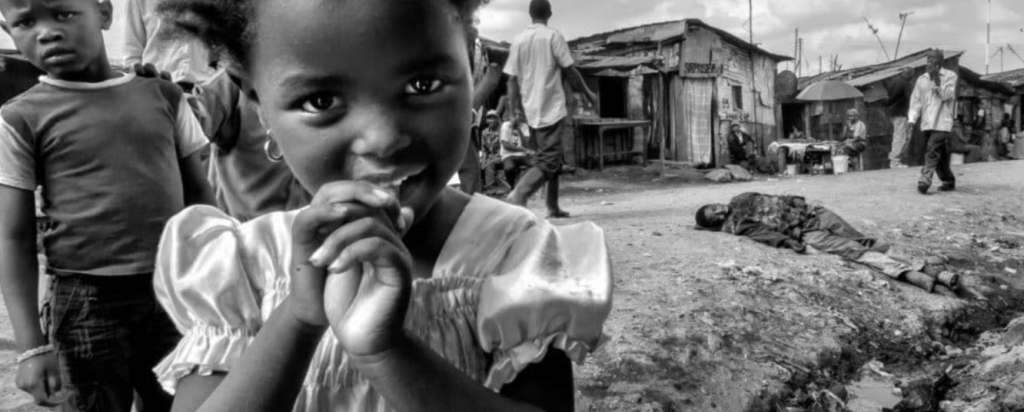
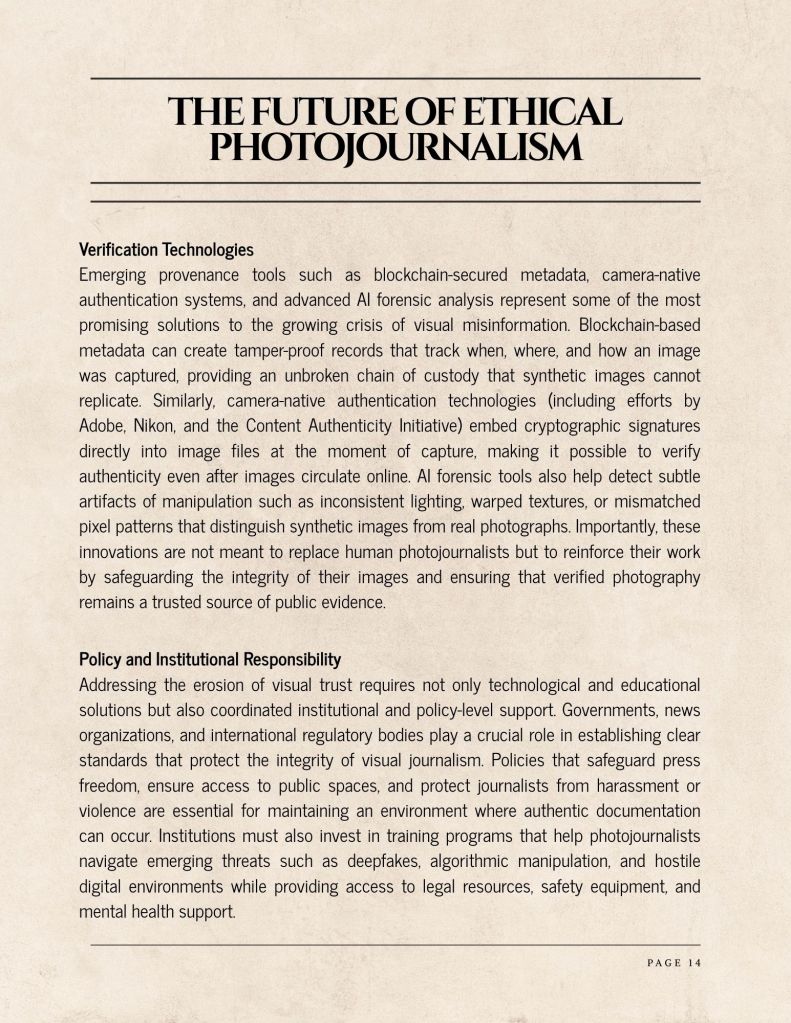
Ethical practices around trauma, vulnerability, and representation discussed in Dahmen’s work require human sensitivity and emotional intelligence. These practices shape how suffering is depicted and help prevent sensationalism or harm.
Human Photojournalism as a Democratic Tool
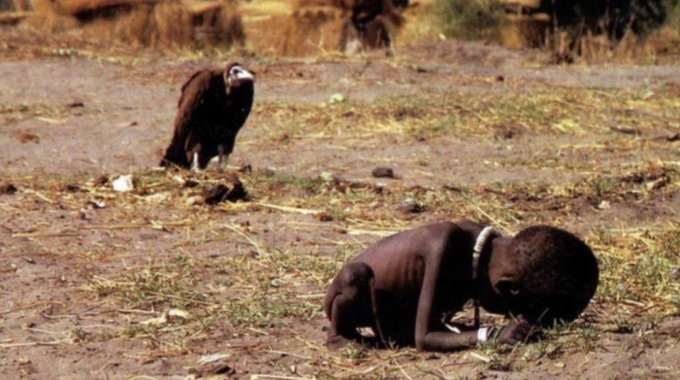
Photojournalists document injustice, challenge official narratives, and create visual transparency necessary for democratic accountability. Whether covering civil rights movements, police violence, or humanitarian crises, their work transforms private suffering into public evidence (Redeker).
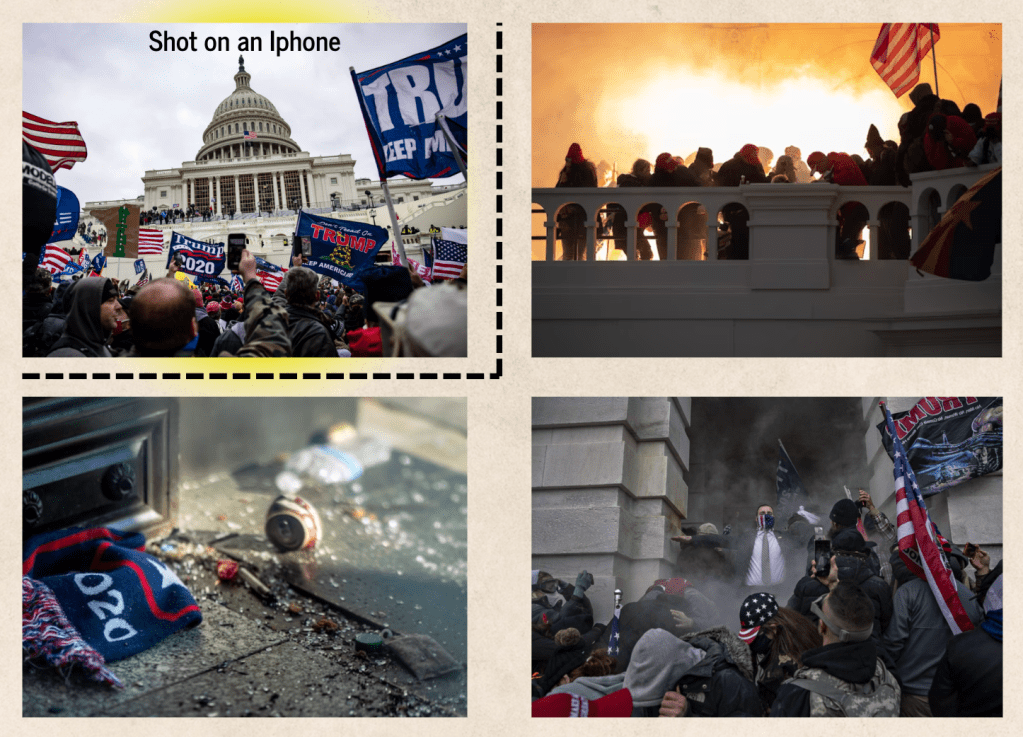
Citizen imagery complements but does not replace professional photojournalism. Professionals provide verification, narrative framing, and ethical oversight essential for transforming raw footage into credible documentation.
The Future of Ethical Photojournalism
Verification Technologies
Emerging provenance tools such as blockchain-secured metadata, camera-native authentication systems, and advanced AI forensic analysis represent some of the most promising solutions to the growing crisis of visual misinformation. Blockchain-based metadata can create tamper-proof records that track when, where, and how an image was captured, providing an unbroken chain of custody that synthetic images cannot replicate. Similarly, camera-native authentication technologies (including efforts by Adobe, Nikon, and the Content Authenticity Initiative) embed cryptographic signatures directly into image files at the moment of capture, making it possible to verify authenticity even after images circulate online. AI forensic tools also help detect subtle artifacts of manipulation such as inconsistent lighting, warped textures, or mismatched pixel patterns that distinguish synthetic images from real photographs. Importantly, these innovations are not meant to replace human photojournalists but to reinforce their work by safeguarding the integrity of their images and ensuring that verified photography remains a trusted source of public evidence.
Policy and Institutional Responsibility
Addressing the erosion of visual trust requires not only technological and educational solutions but also coordinated institutional and policy-level support. Governments, news organizations, and international regulatory bodies play a crucial role in establishing clear standards that protect the integrity of visual journalism. Policies that safeguard press freedom, ensure access to public spaces, and protect journalists from harassment or violence are essential for maintaining an environment where authentic documentation can occur. Institutions must also invest in training programs that help photojournalists navigate emerging threats such as deepfakes, algorithmic manipulation, and hostile digital environments while providing access to legal resources, safety equipment, and mental health support.
Conclusion
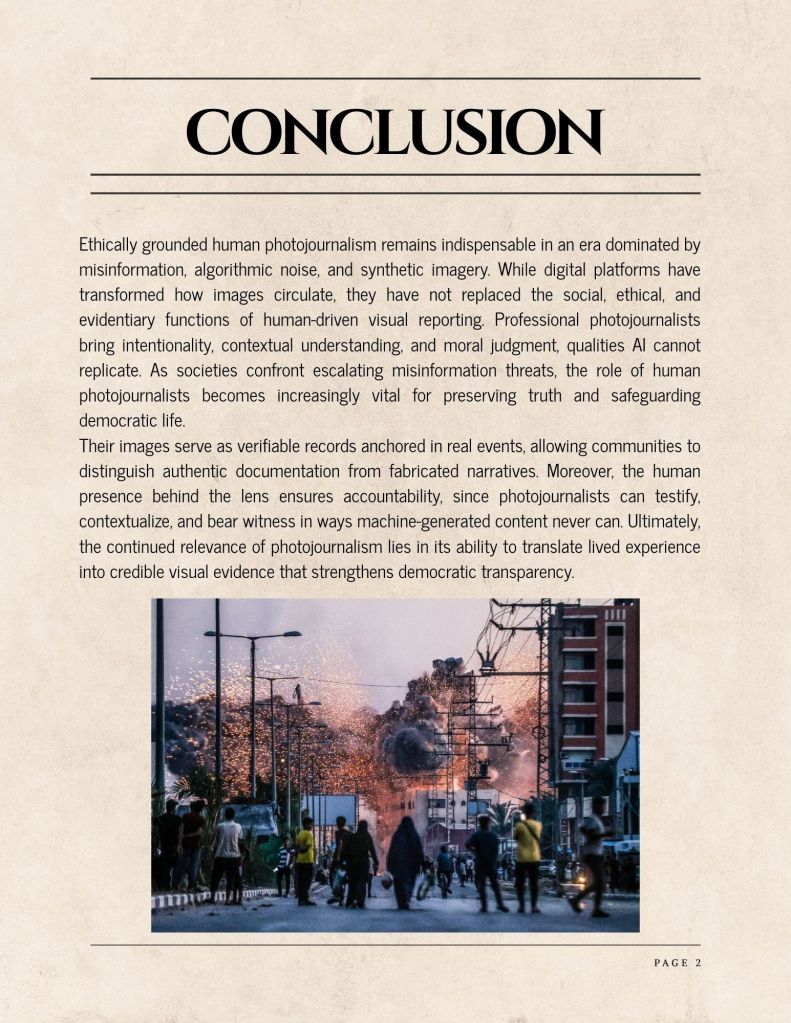
Ethically grounded human photojournalism remains indispensable in an era dominated by misinformation, algorithmic noise, and synthetic imagery. While digital platforms have transformed how images circulate, they have not replaced the social, ethical, and evidentiary functions of human-driven visual reporting. Professional photojournalists bring intentionality, contextual understanding, and moral judgment, qualities AI cannot replicate. As societies confront escalating misinformation threats, the role of human photojournalists becomes increasingly vital for preserving truth and safeguarding democratic life.
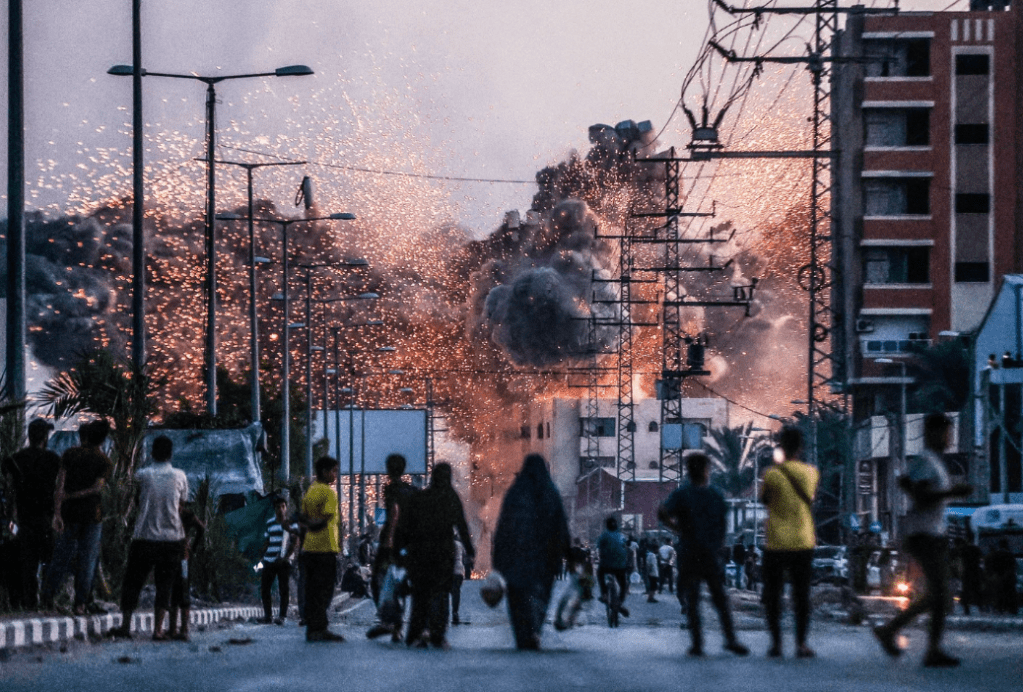
Their images serve as verifiable records anchored in real events, allowing communities to distinguish authentic documentation from fabricated narratives. Moreover, the human presence behind the lens ensures accountability, since photojournalists can testify, contextualize, and bear witness in ways machine-generated content never can. Ultimately, the continued relevance of photojournalism lies in its ability to translate lived experience into credible visual evidence that strengthens democratic transparency.



 Levy It All To Me