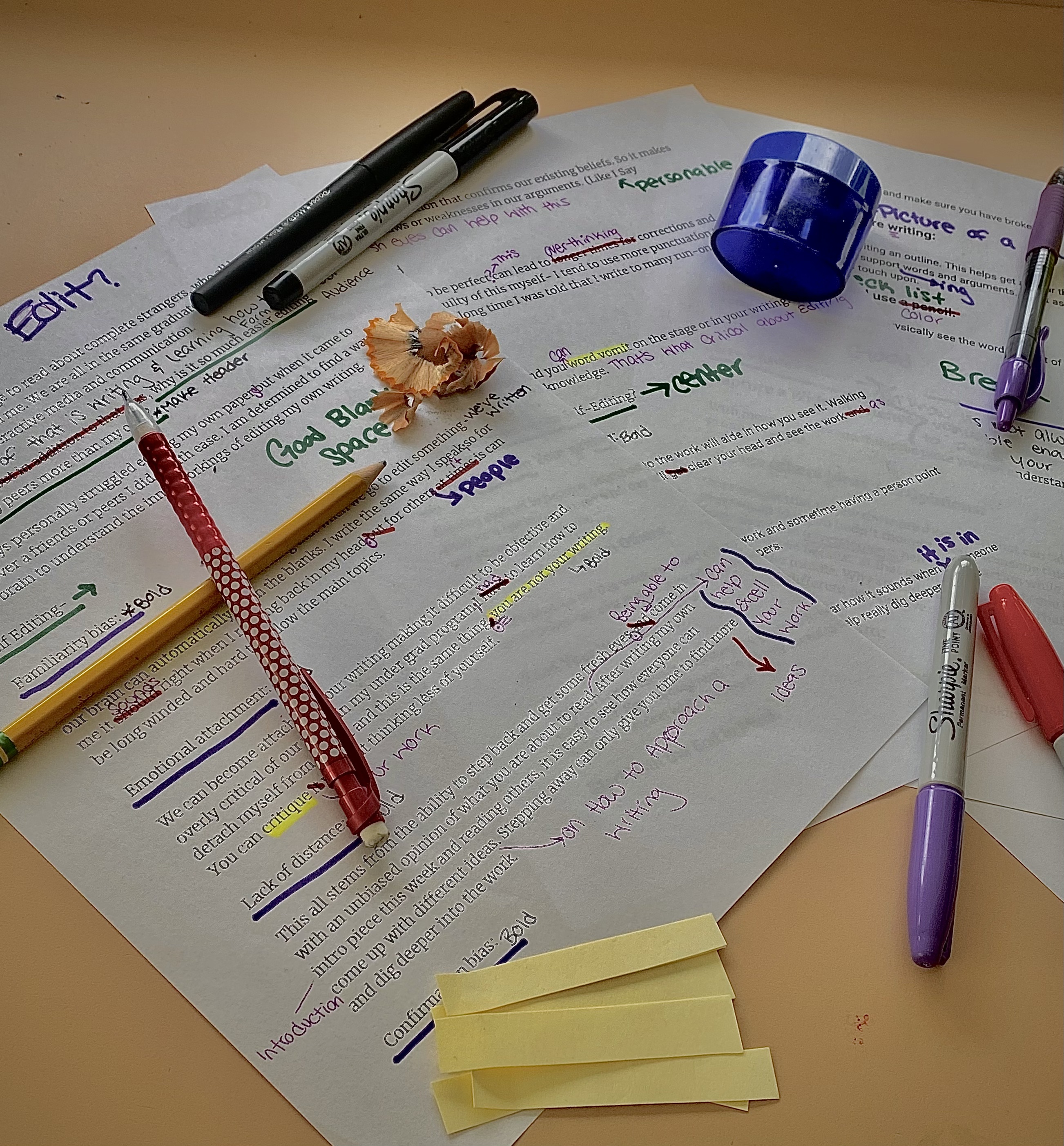
This week, I had the privilege to read about strangers, who all have one thing in common with me. We are all in the same graduate school program to learn more about interactive media and communication. A large part of that is writing and learning how to edit and format for our audiences.
Why is it so much easier to edit the papers of my peers than my own?
I have always personally struggled editing my own papers but when it came to looking over friends or peers I did it with ease. I am determined to find a way for my brain to understand the inner workings of editing my writing.
Self Editing
Familiarity Bias:
We are so used to our writing style that when we go to edit something we’ve written our brain can automatically fill in the blanks. I write the same way I speak; so for me, it sounds right when I read back in my head. For other people, it can be long-winded and hard to follow the main topics.
Emotional Attachment:
We can become attached to our writing making it difficult to be objective and overly critical of our work. In my undergrad program, I had to learn how to detach myself from my art and this is the same thing. You are NOT your writing! You can critique your work without thinking less of yourself.
Lack of Distance:
This all stems from the ability to step back and get some fresh eyes. Being able to approach with an unbiased opinion of what you are about to read can help excel in your work. After writing my introduction piece this week and reading others, it is easy to see how everyone can come up with different ideas on how to approach writing. Stepping away can only give you time to find more ideas and dig deeper into the work.
Confirmation Bias:
We tend to focus on information that confirms our existing beliefs. So it makes it harder to identify flaws or weaknesses in our arguments. (Like I Say ‘Flawless’) Fresh eyes can help with this.
Perfectionism:
Need something to be perfect? This can lead to overthinking corrections and overcorrecting the work. I am guilty of this myself- I tend to use more punctuation than necessary. For a long time, I was told that I wrote to many run-on sentences.
Data Dumping:
This is like brain overload, and you can word vomit on the stage or in your writing. An explosion of opinions and knowledge. This is why editing is so crucial to pairing back and refining work.
How Can We Improve Our Self-Editing?
Take Breaks from Your Writing:
Allowing yourself to become detached from the work will aid in how you see it. Walking away for a few hours or even a full day will clear your head and see the work as something fresh and new.
Seek Feedback From Others:
That’s what we did this week, reviewed others’ work and sometimes having a person point off mistakes can aid in any future editing of papers.
Read Your Work Aloud:
You aren’t just seeing it on paper now you have to hear how it sounds when it is in someone else’s head. Sometimes, I read it in a funny accent to help really dig deeper into the audience’s mindset while reading it.
Start With the End in Mind:
Try to know the bigger picture and make sure you have broken it all down so that it makes sense as a layout.
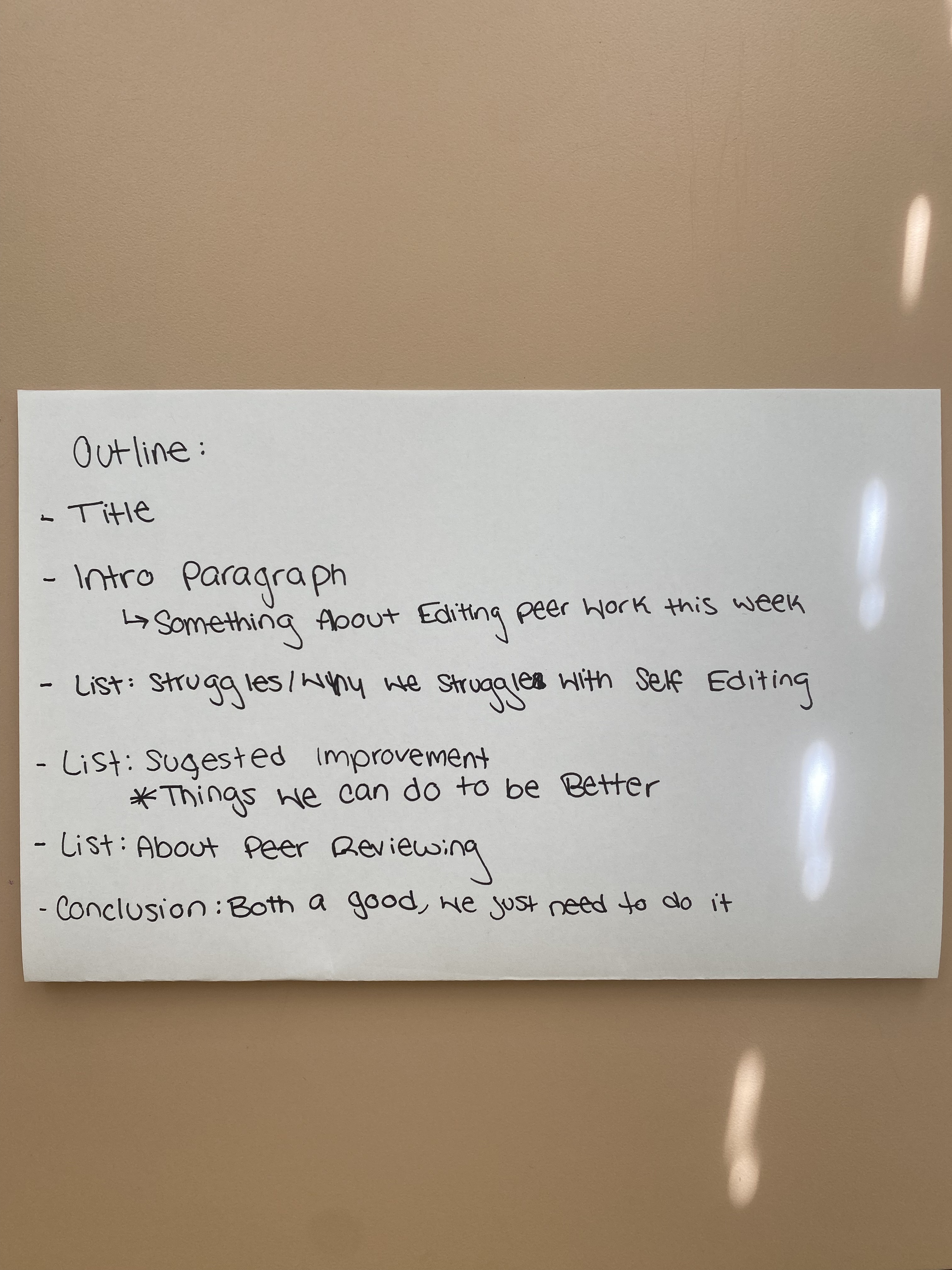
Create an Outline Before Writing:
Spend a little extra time writing an outline. This helps get all your thoughts down and organized before you add supporting words and arguments. Use it as a checklist for everything you want to touch upon.
Make a Hard Copy and Use Color:
This is a great idea, hand edit, and physically see the words in front of you. Honestly, if I had a printer I might do this more. TO LATE I DID IT! (Pictured at the top)
Is Peer Review Better?
I know it’s not always easy to be vulnerable enough for people/peers to read your work but it is so effective and necessary.
Capture a Wider Audience:
With more eyes on something the more you can understand and target a wider group of people.
Engage Other’s Ideas and Opinions:
The more people that review the more discussion that can take place, maybe even add ideas you hadn’t thought about. Someone this week hit on a strong point about advertisements on the sidebar, being a distraction while reading articles. It stood out to me because at that point the website is one big ad with some writing in the middle. Why should we care about it? That stuck with me, and I appreciated a different perspective.
Appropriate Criticism:
Finding the proper way to articulate an issue with someone else’s writing can help you better understand why you keep making similar mistakes.
So the real question isn’t whether or not you self or peer review your writing. It’s whether you review it at all. Rome wasn’t built in a day, you ARE going to make mistakes that’s called being human.
 Levy It All To Me